The new Gravitational Wave Transient Catalogue (GWTC-5)
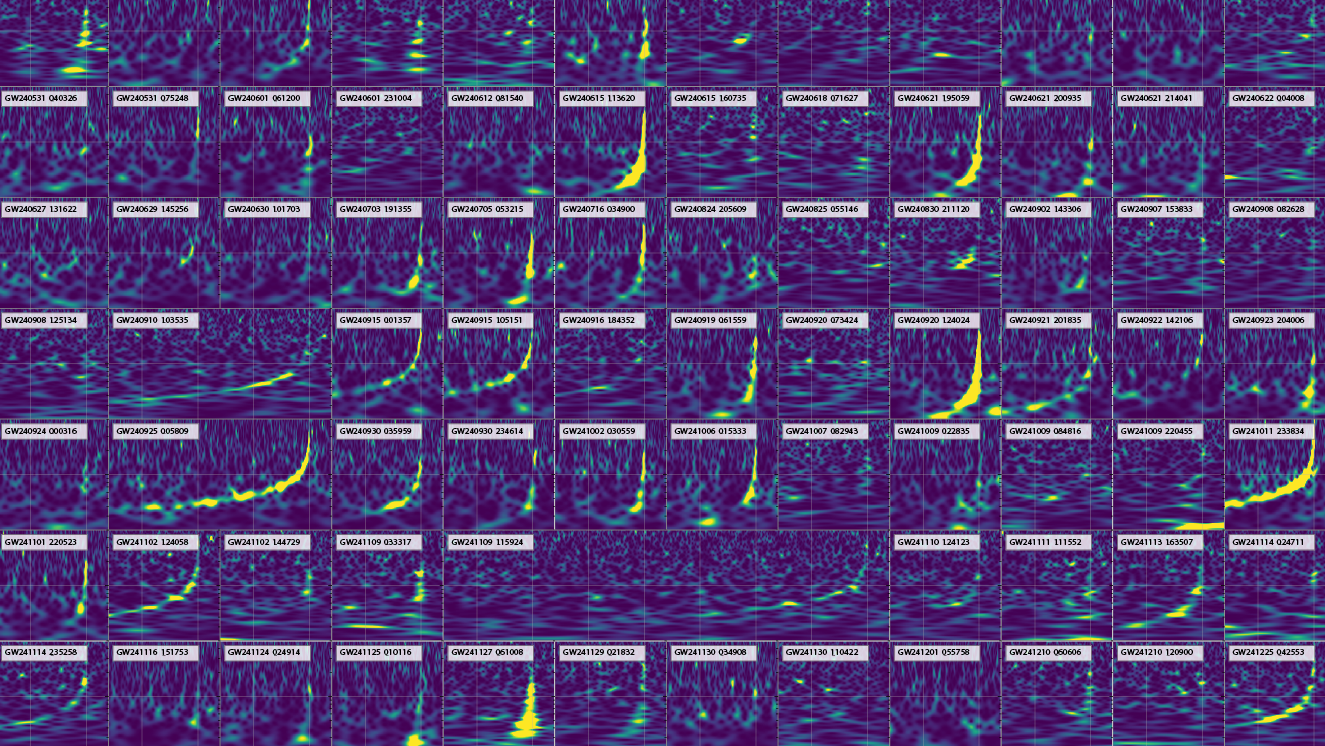
The LIGO–Virgo–KAGRA Collaboration published today a new catalog of gravitational wave events. A total of 161 events, detected between April 2024 and the end of January 2025, have been added to the collection, bringing the total number of gravitational wave signals detected to date to 390. Among the most significant findings are: evidence for the existence of second-generation black holes, the most precise sky localization ever achieved for a gravitational wave source, and the first measurement of three vibrational modes of a black hole. A wealth of results that marks the coming of age of gravitational astronomy.
The Best Sky Localization Ever Achieved
A signal detected by the two LIGO detectors in the United States and Virgo in Europe on June 15, 2024 — and therefore called GW240615 — set the record for the most precise sky localization among all gravitational wave events observed to date. The source was identified within an area of just 6 square degrees, a relatively small portion of the celestial sphere. This exceptional performance was achieved thanks to the triangulation using data from all three detectors active at the time, including Virgo, which rejoined the observing campaign in April 2024 at the beginning of O4b, contributing significantly to the network’s source-localization capabilities.
Improvements in the network’s ability to localize events, along with the increase in the size of the dataset, also allowed for a better estimate of the Hubble constant, H0 which indicates how fast the Universe is currently expanding. Using the GWTC-5 dataset, the LVK collaboration obtained a new, independent measurement of the Hubble constant, $H_0 = 71^{+9}_{-7} kms/s/Mpc$, which is just over 25% more precise than the estimate coming from the previous catalog release. This value is entirely consistent with long-established measurements from both our cosmic neighbourhood and the early Universe but is not yet precise enough to resolve the tension between those measurements.
The Clearest gravitational wave Signal Ever Recorded
Detecting gravitational waves does not simply mean capturing a signal, but extracting it from the noise that disturbs the detectors. This requires intense noise-mitigation efforts and highly sophisticated data analyses, which is why the “strength” or “clarity” of a signal is expressed through the signal-to-noise ratio (SNR). The catalog published today includes the “clearest” gravitational wave signal ever detected, with a signal-to-noise ratio of 76.9. This signal, GW250114, reached Earth on January 14, 2025 and was generated by the merger of two black holes with nearly identical masses (32 and 34 times the mass of the Sun, respectively), occurring more than one billion light-years from Earth. Its “clarity” has led to some exceptional scientific results, which have already been published and announced by the LVK collaboration in recent months, including the most accurate test of general relativity ever performed and confirmation of Stephen Hawking’s black hole area theorem.
Second Generation Black Holes
Another outstanding result, included in the new catalog published today—though it had already been announced by the LVK Collaboration in recent months—concerns two very special events: GW241011 and GW241110. These signals, detected in October and November 2024, just one month apart, were generated by two black hole mergers, located approximately 700 million and 2.4 billion light-years from Earth, respectively. Certain characteristics of these mergers — in particular the spin of the black holes (that is, the orientation and speed of their rotations) — indicate the objects involved could be ‘second-generation’ black holes, meaning black holes that are themselves the result of previous coalescences. These objects likely formed in very dense and crowded cosmic environments, such as stellar clusters, where black holes are more likely to collide and merge repeatedly. The growing number of observed events has also enabled researchers to study and increasingly clearly identify the properties of different populations of black holes, and one of the articles accompanying the Catalogue deals precisely with this specific aspect.