Gravitational wave detectors can now ‘auto-tune’ their signals
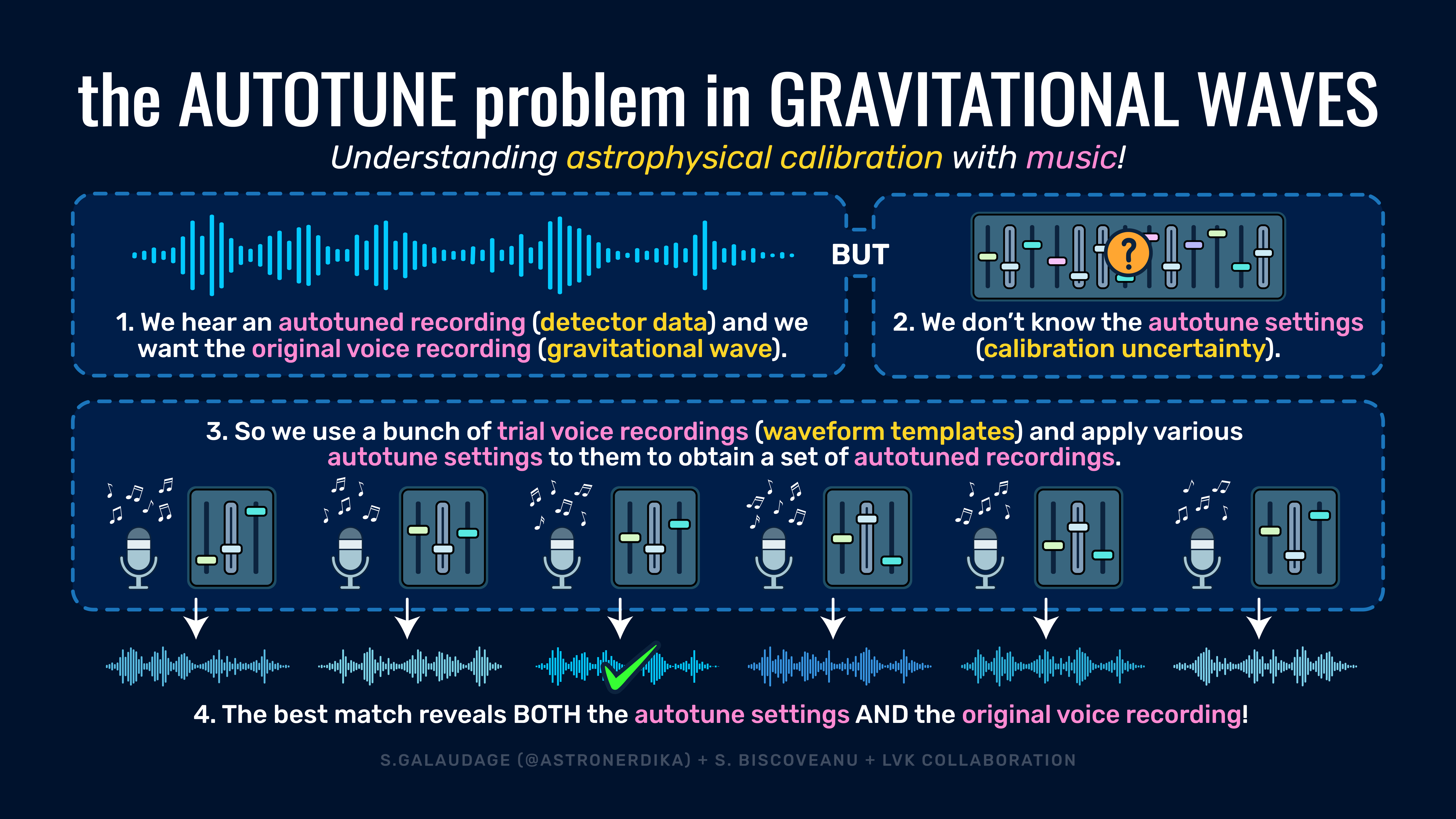
The LIGO–Virgo–KAGRA (LVK) detector network has a new trick up its sleeve to improve the instruments’ sensitivity to gravitational waves: it’s called Astrophysical Calibration and it plays a role similar to auto-tune in music production.
When a gravitational wave passes through the Earth, the LIGO, Virgo and KAGRA detectors are ready to detect it, but their sensitivity depends on many factors and it is possible that one of them may not be operating at full capacity at that moment. In moments like these, it is essential to be able to process the data collected by that detector to improve its quality, and the network of detectors now has a new efficient tool to do so: Astro Calibration.
Gravitational waves distort space, stretching and compressing it as they pass through. This effect on the detector arms is around $10^{-19}$ m, far smaller than the diameter of a proton! To be sensitive to such tiny changes, the detectors must be carefully calibrated in real time, using feedback control circuits and a precise procedure that models how the detector changes as the waves pass through it, whilst also taking into account the effects generated by the control circuits themselves. If the calibration is not optimal, the ‘reading’ of the signal and therefore the interpretation of the cosmic phenomenon that generated it are compromised.
However, if the gravitational signal detected is sufficiently strong – that is, when it clearly outweighs the background noise – comparing the signal to predictions from general relativity (together with comparison of the signals observed in other detectors), can be used to recalibrate the data from a ‘mis-tuned’ detector retrospectively.
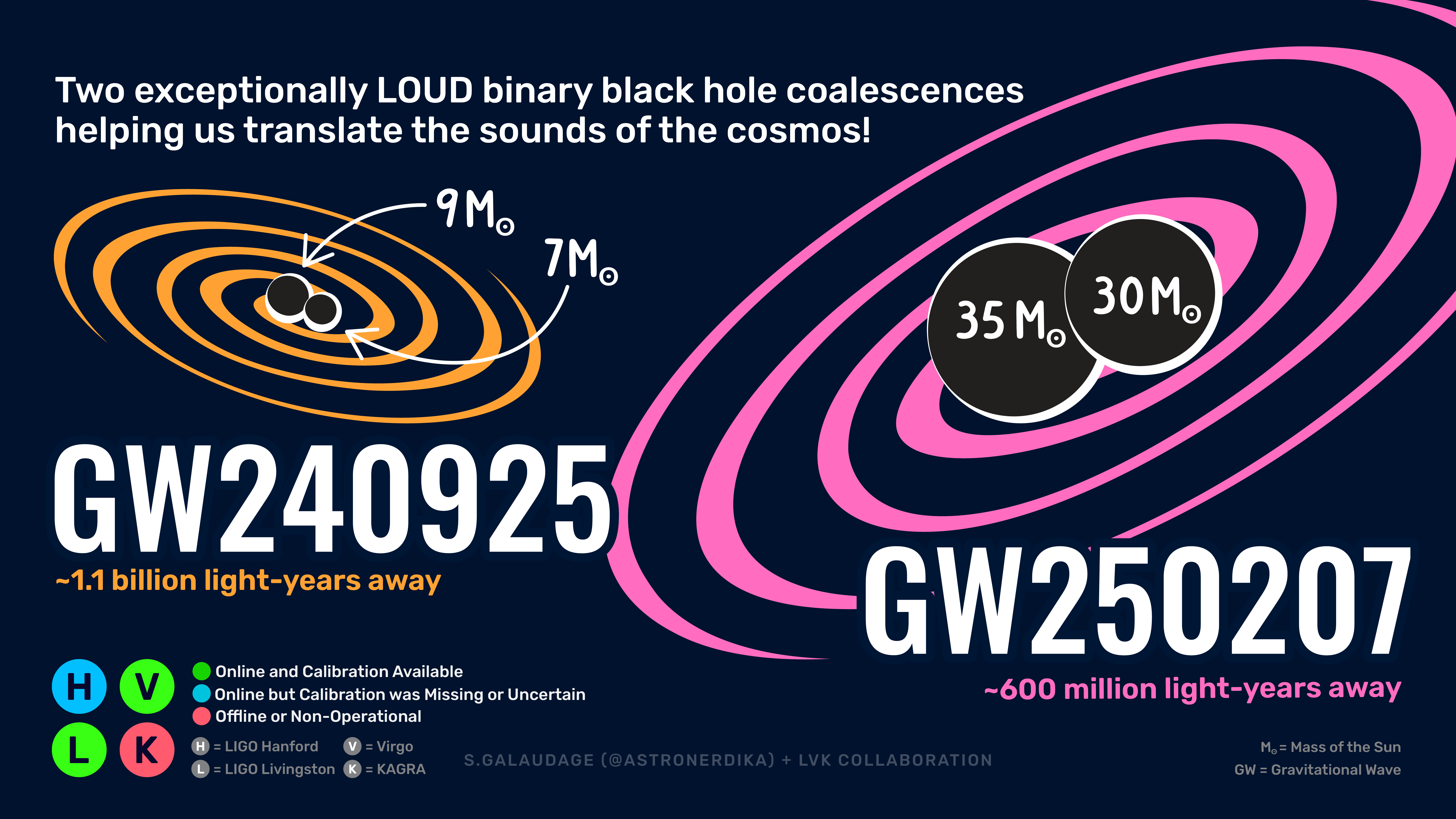
In an article accepted in Physical Review Letters Researchers from the LIGO–Virgo–KAGRA (LVK) Collaboration demonstrate how this technique has been applied to two particularly intense and interesting signals, GW240925 and GW25020, where, as always, the signal name indicates the date of the detections, which were detected in September 2024 and February 2025 respectively. At the time both these signals arrived, the LIGO Hanford detector (in Washington, USA) was not in optimal condition, making the interpretation of its data particularly difficult.
By comparing the predicted signals with the observed ones, the researchers were able to draw precise conclusions about how the LIGO Hanford detector distorted the data collected simultaneously by the LIGO Livingston detector in Louisiana and the Virgo detector in Italy. For GW240925, this method confirmed the known calibration errors measured on-site. For GW250207, however, it was essential to resort to astro calibration as no reliable on-site calibration measurements were available.
Using the corrected calibration for the LIGO Hanford detector, LVK researchers have discovered that GW240925 was generated by black holes with masses 9 and 7 times that of the Sun at a distance of approximately 350 megaparsecs from Earth, whilst GW250207 was generated by two black holes with masses 35 and 30 times that of the Sun at a distance of approximately 200 megaparsecs from Earth. Without taking calibration uncertainties into proper account, these estimates could have been biased towards an incorrect value.